For practices
The basics of billing CCM and CPO
The requirements and common codes for chronic care management and care plan oversight, plus the mistakes that can leave you paying money back.
4 minute readBy the Fieldstone Billing teamUpdated
Chronic care management (CCM) and care plan oversight (CPO) pay for work that happens between visits, like the nurse who spends 25 minutes in a month sorting out a patient’s refills and chasing a cardiology note. They also come with a long list of requirements, and those need to be in place before you bill. Treat this guide as a starting point, and check the current CMS care management guidance and the payer’s rules before any claim goes out.
Chronic care management
CCM is generally for patients with two or more chronic conditions that are expected to last at least 12 months, or until death, and that put the patient at significant risk.
| Code | Generally used for |
|---|---|
| 99490 | First 20 minutes of clinical staff time in a calendar month |
| 99439 | Each additional 20 minutes of clinical staff time |
| 99491 | First 30 minutes personally provided by a physician or qualified professional |
| 99487 | Complex CCM, first 60 minutes of clinical staff time |
| 99489 | Each additional 30 minutes of complex CCM |
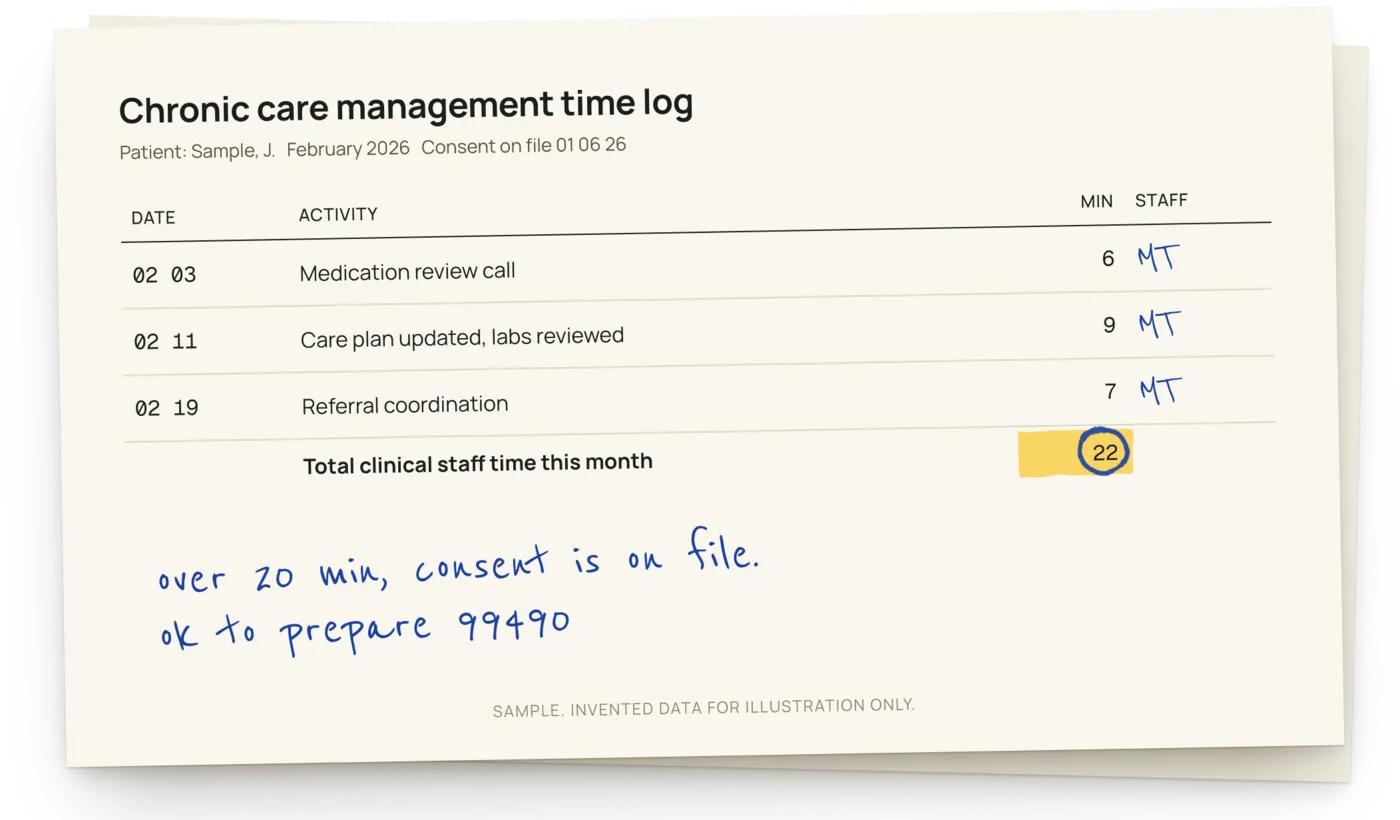
The minutes belong to the calendar month. If your nurse logs 18 minutes in March, you can’t bill 99490 for March, and those 18 minutes don’t carry over into April.
Common requirements include an initiating visit for new patients or patients who haven’t been seen in the past year, along with documented patient consent, a comprehensive care plan (that’s the CMS term for it), time tracking and access to care. For Medicare, access means patients can reach your practice around the clock for urgent needs, so ask yourself who picks up on a Saturday night before you enroll anyone.
Care plan oversight
CPO recognizes physician oversight of patients under home health or hospice care.
| Code | Generally used for |
|---|---|
| G0181 | Physician or allowed practitioner oversight of a home health patient, 30 minutes or more in a calendar month |
| G0182 | Physician oversight of a hospice patient, 30 minutes or more in a calendar month |
The time has to be tracked, and it has to be spent on qualifying activities. A physician reviewing a change to a home health plan and calling the agency nurse about it is the kind of work people have in mind, but check the current rules on which activities count and who else can bill during the same period. A month with 25 tracked minutes doesn’t reach either code.
Related programs
You’ll run into these as well, and each one has its own rules.
- Remote physiologic monitoring uses codes such as 99453, 99445, 99454, 99470 and 99457. Since January 1, 2026, Medicare also pays for 2 to 15 days of data (99445) and the first 10 minutes of management (99470).
- Principal care management uses codes 99424 to 99427, for a single high risk condition.
- Behavioral health integration uses codes such as 99484, with their own requirements.
- Advanced primary care management uses G0556 to G0558, a monthly bundle that combines elements of care management services, with G0568 to G0570 as behavioral health add on codes since January 1, 2026.
Mistakes that can mean paying money back
Billing without consent on record is the first one to look for. Consent should be documented before the service starts, so if the nurse begins calling a patient in February and the consent note is dated March, you have a problem with those February minutes. Medicare accepts verbal or written consent as long as it’s documented. CMS also wants the patient told that only one practitioner can bill for CCM in a month and that they can stop at any time.
Cost share belongs in that same conversation. Patients may owe coinsurance, and they should understand that when they consent, because a patient who never came into the office isn’t expecting a bill and will call to ask about it.
Estimating time is another. Record minutes when the work happens. Minutes that someone puts together at the end of the month, or rounds up because the claim needs 20, are very hard to defend.
Then there’s billing incompatible services together, since some programs can’t be billed with each other. For example, CCM can’t be billed in the same service period as G0181 or G0182, and the same practitioner can’t bill CCM and PCM for a patient concurrently. Picture a CCM patient who starts home health in the middle of the year. The doctor begins logging CPO time while the nurse keeps logging CCM, and nobody compares the two lists until the claims have gone out.
Copied notes cause trouble too. Time entries should reflect the work performed that month, and if the same line about reviewing medications shows up word for word for a year, it’s hard to show that anything specific happened in any of those months.
Who does what
The care and its supervision stay with your practice, and so does the documentation. A billing company can check prerequisites, confirm that recorded time meets the requirements, catch incompatible billing and prepare the claims. It should never create documentation to support a claim, so if the minutes aren’t in the log, that month doesn’t get billed. You can read about our care management billing support.
Starting small
Start with a small group of suitable patients and get the consent and time tracking right before you grow. A small program with good documentation is much safer than a large one with gaps, and you can always add patients later.