For practices
Common claim denial codes and where to start on each
What the common claim adjustment codes usually mean, and how to work out what went wrong on a claim before you decide what to do next.
4 minute readBy the Fieldstone Billing teamUpdated
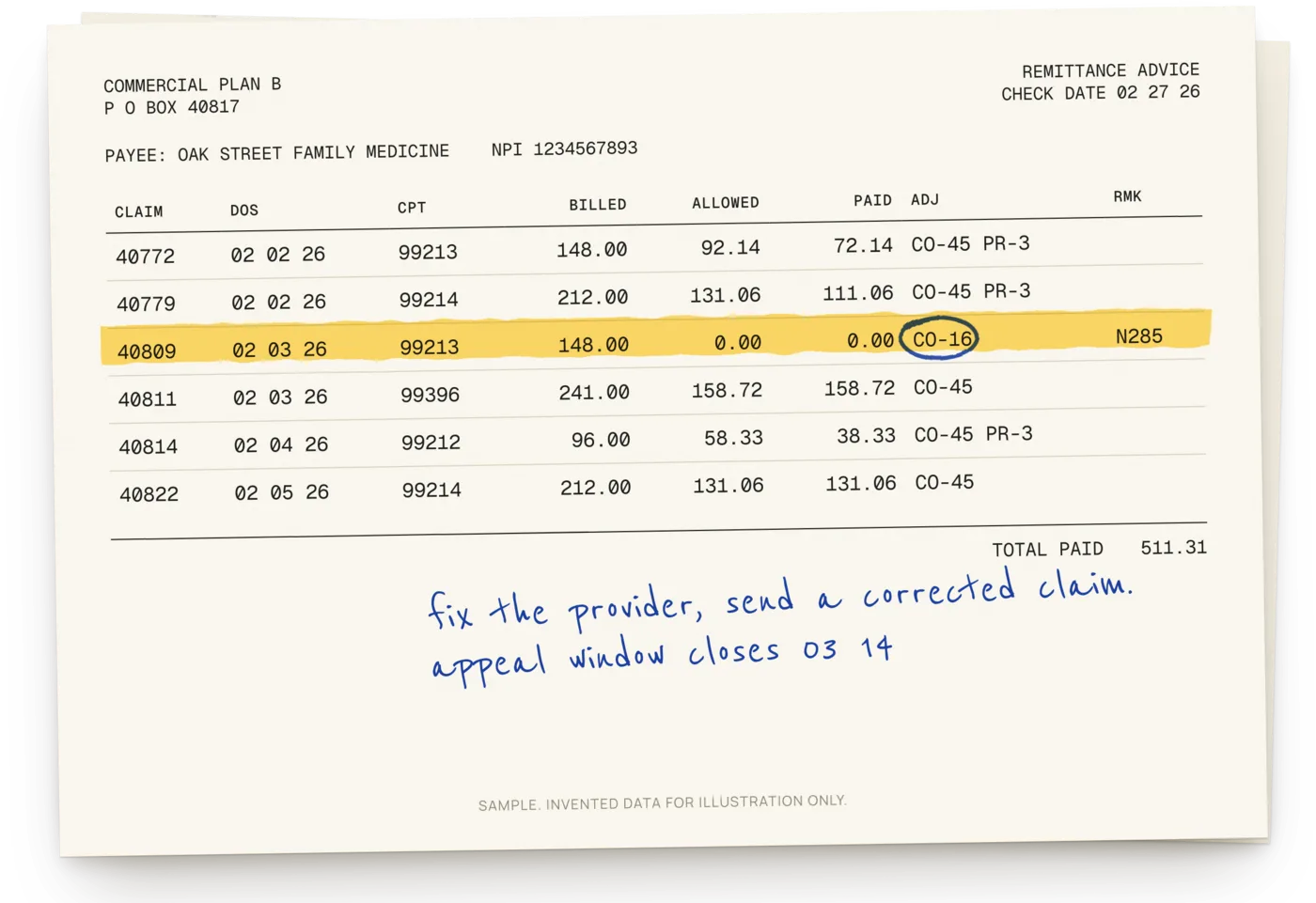
The code on a denial tells you the payer’s reason category and not a lot else. X12 maintains the official list of claim adjustment reason codes, and it’s worth keeping handy, but the fix depends on the claim, the plan and any remark code that came with it. Two CO-16 denials on the same morning can need completely different fixes.
Reading an adjustment on the remittance
Each adjustment on a remittance has two parts, a group code and a reason code. The group code is the letters in front.
- CO means contractual obligation. The amount generally isn’t billable to the patient.
- PR means patient responsibility, such as a deductible or coinsurance.
- OA means other adjustment.
- PI means payer initiated reduction.
Read the remark codes too, because they often tell you exactly what was missing. A CO-16 on its own only says something is wrong with the claim, while a CO-16 with remark code N290 points you at the rendering provider’s identifier. On Medicare claims, remark code MA130 means the claim couldn’t be processed and has no appeal rights, so you fix it and send a new one.
The codes you’ll see most
| Code | What it usually means | Where to start |
|---|---|---|
| CO-16 | Claim lacks information or has a billing error | Read the remark code, correct what’s missing, then resubmit |
| OA-18 | Exact duplicate of a claim or service | Check whether the original was paid or is still processing before you do anything |
| CO-22 | Another payer may be primary | Check coordination of benefits with the patient and payer |
| CO-29 | The time limit for filing has expired | Look for proof of timely filing, or any applicable exception |
| CO-45 | Charge exceeds the fee schedule or contracted amount | Usually an expected adjustment, but confirm it matches your contract |
| CO-50 | Not considered medically necessary by the payer | Review documentation and coverage policy, then consider an appeal |
| CO-97 | Payment is included in another service | Review bundling edits and whether a modifier is supported |
| CO-197 | Precertification or authorization is absent | Look for an existing authorization, then check the options for a retroactive one |
| PR-1 | Deductible amount | Bill the patient as your policy and contract allow |
| PR-2 | Coinsurance amount | Bill the patient, or any secondary coverage |
Payers don’t all use these codes the same way, so check the payer’s own policy before you act.
Take a CO-197 on a knee MRI. Before you write an appeal, look through the chart and the payer portal for an authorization. Somebody may have gotten one and never put the number on the claim, in which case you’re sending a corrected claim. If nobody got one, the question becomes whether this payer will consider a retroactive authorization, and that varies a lot from one payer to the next.
Picking the route
If the claim was rejected, the payer stopped it before processing, so there’s nothing to appeal. Fix it and resubmit it as a new claim, and see claim rejection or denial for more on telling the two apart.
Use a corrected claim when the claim contained an error you can fix. Medicare Part B generally handles minor errors on a processed claim through a clerical error reopening, requested within one year.
Use a reconsideration or appeal when the claim was right and the payer’s decision seems wrong.
Each route has its own deadline. Medicare generally allows 120 days from the date you receive the initial determination to request a redetermination, and receipt is presumed five days after the notice date. Commercial appeal limits depend on the plan and contract. Our guide to timely filing limits has more on those.
Stopping the same denial from coming back
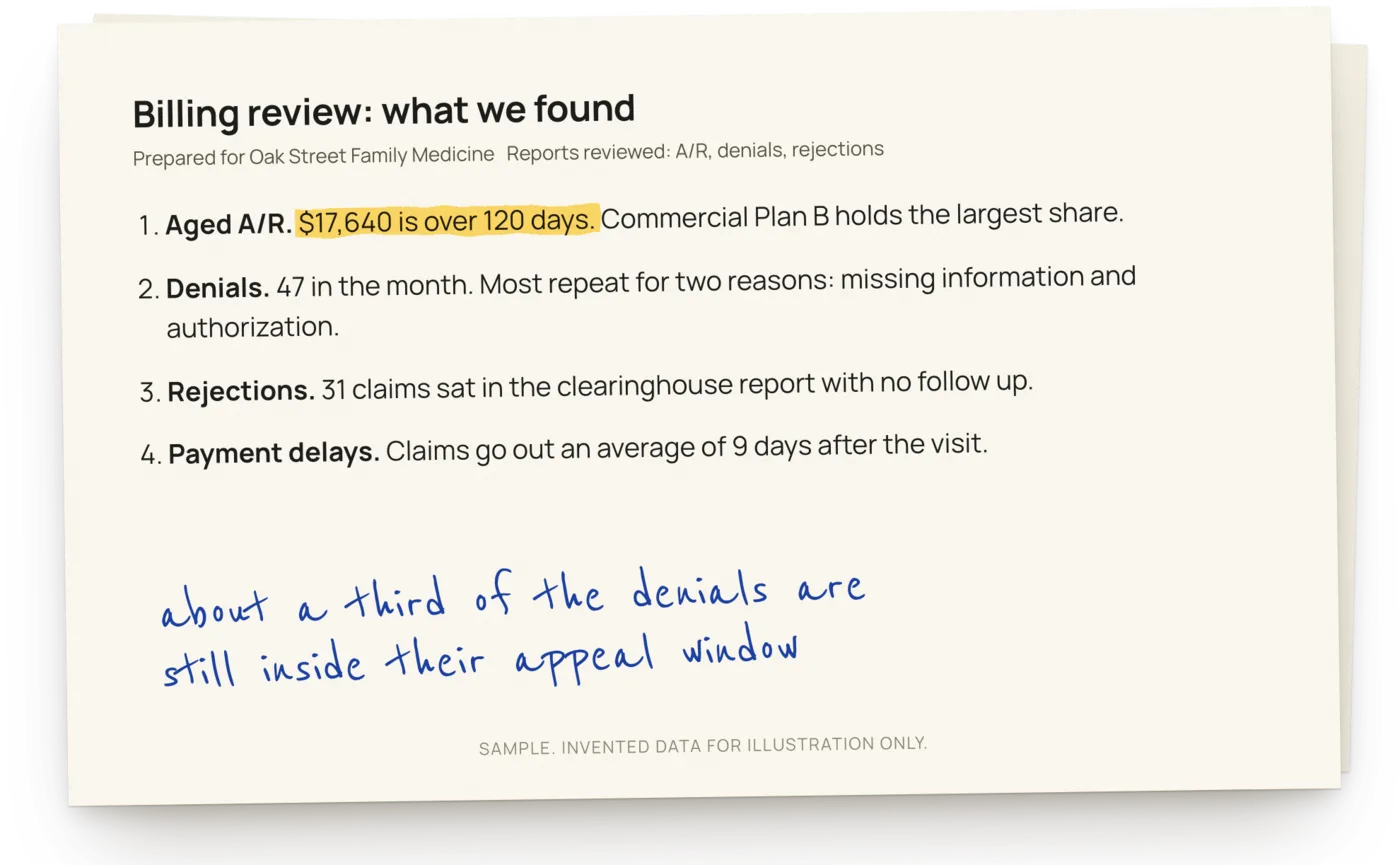
Track each denial by reason and payer. After a few months you’ll usually see a small number of causes behind most of them, and the fix may sit at the front desk, in enrollment or in a template, somewhere well outside the billing office. A run of CO-22 denials, for example, may mean nobody is asking about other coverage at check in. This tracking is the core of good denial management.
Modifiers and code changes
Never add a modifier or change a code only to get a claim paid. Any change has to be supported by the documentation.
This guide is general information. Rules vary by payer and change over time.