For owners of medical billing companies
Sell your medical billing business to someone who'll look after your clients
You've spent years earning those clients. We're looking to buy small billing companies and client portfolios, pay you a share of the revenue over an agreed period, and take over at a pace you're comfortable with. Send us your numbers under an NDA and we'll give you a written estimate.
Non binding, and an NDA comes before client names
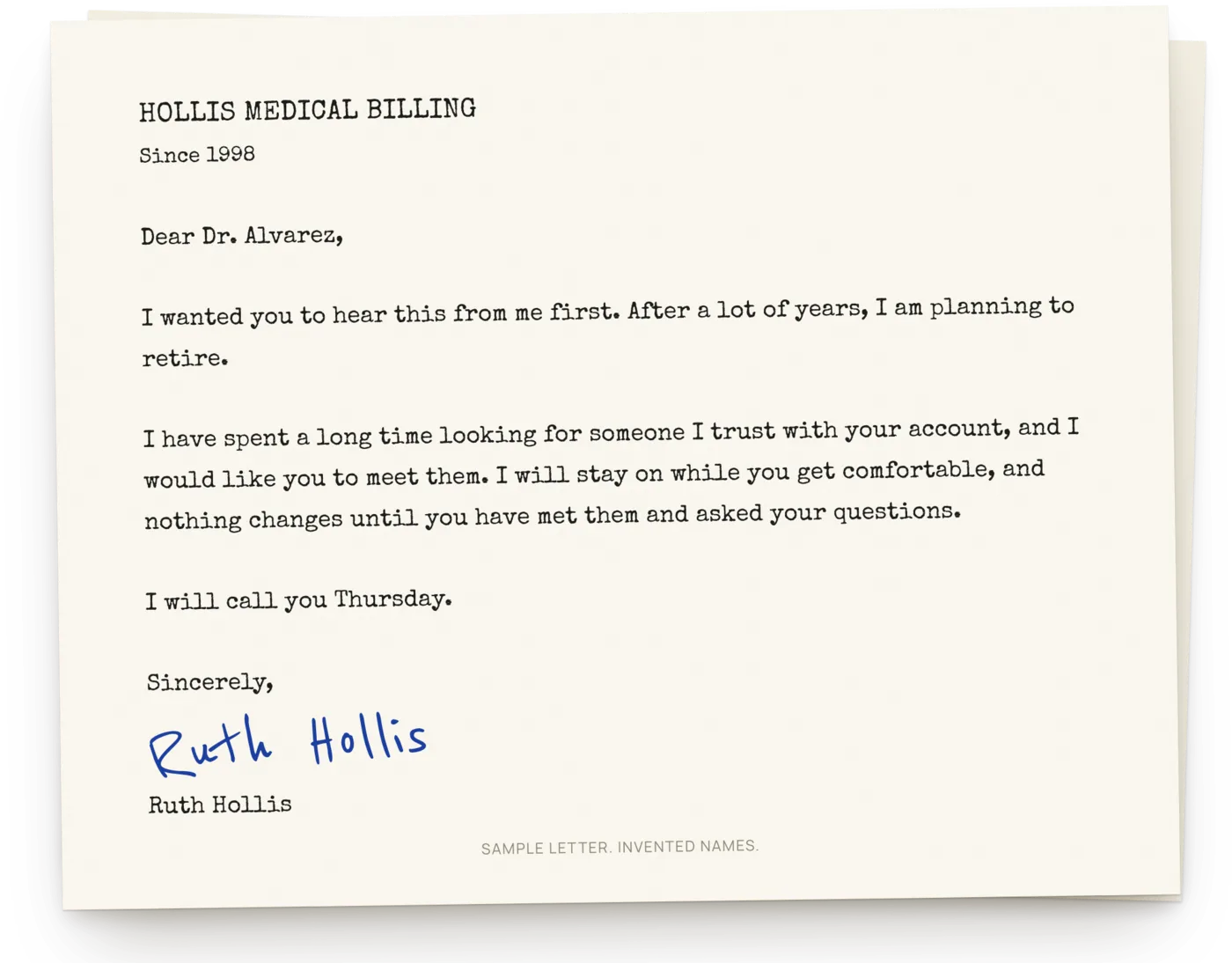

Before you sell
Four things you'll want answered
What happens to my clients?
Some of them have been with you for twenty years. You'll want to know who's picking up the phone once you've gone.
Will I be paid fairly?
A client list with one person behind it is hard to value, and listing sites aren't much help.
Can I leave at my own pace?
You might want out by next quarter, or you might want to ease off over a couple of years. Either can work.
Will word get out?
Your clients and staff shouldn't hear about this until you're ready to tell them.
Your options
Three ways this could go
- 1
Sell your client portfolio
We're looking to acquire the client relationships you choose to transfer, subject to client approval and contract terms. You'd help with the introductions, and those need some care.
- 2
Step back from the work gradually
You cut your hours as we take on more of the work, and you retire once the clients have settled in and you're ready.
- 3
Sell the whole business
Where it makes sense, we'd consider buying the entire company, staff and systems included. That takes more diligence, since there's more to look through, and we'll explain what's involved.
The handover
Who's doing the work, and when you get paid
Today
You're still running the accounts, and clients call you.
Side by side
We work next to you for a while so clients can get to know us. Revenue share payments begin once accounts transfer.
After you step back
We've got the accounts, and your share keeps paying for the agreed period.
This shows one possible structure. We'd agree on every term with you.
Revenue share
Paid from revenue, over time
We don't offer interest bearing seller notes. Our preferred structure pays you a share of what your clients actually pay, for a period we agree on together.
You should know the downside. If clients leave, or we don't run the accounts well, your payments go down too. That's why we'd plan the handover carefully with you, and why you should have the right to check the numbers behind every payment.

Try it with your own numbers
This is plain arithmetic, so choose whatever numbers you like. Move the last slider to see what losing clients would do to the payments.
- Total in this example
- First month
Estimated monthly payment to you
This is only an example using the numbers you choose, and it isn't an offer. Every term gets negotiated with each owner and depends on diligence.
The process
What a sale looks like
- 1
A short call
You tell us what you're considering. We don't need documents or client names for this.
- 2
NDA
We sign a non disclosure agreement before you share anything sensitive.
- 3
Your numbers
You show us revenue by client and your contract terms, and you walk us through how the work gets done.
- 4
A written estimate
We send you a non binding estimate of what we might pay and how you'd get paid: the structure, the share and the period. It's yours to compare with anything else.
- 5
Agreements and client approval
Lawyers finalize the terms. Then we tell clients together and get consents or new agreements.
- 6
Handover
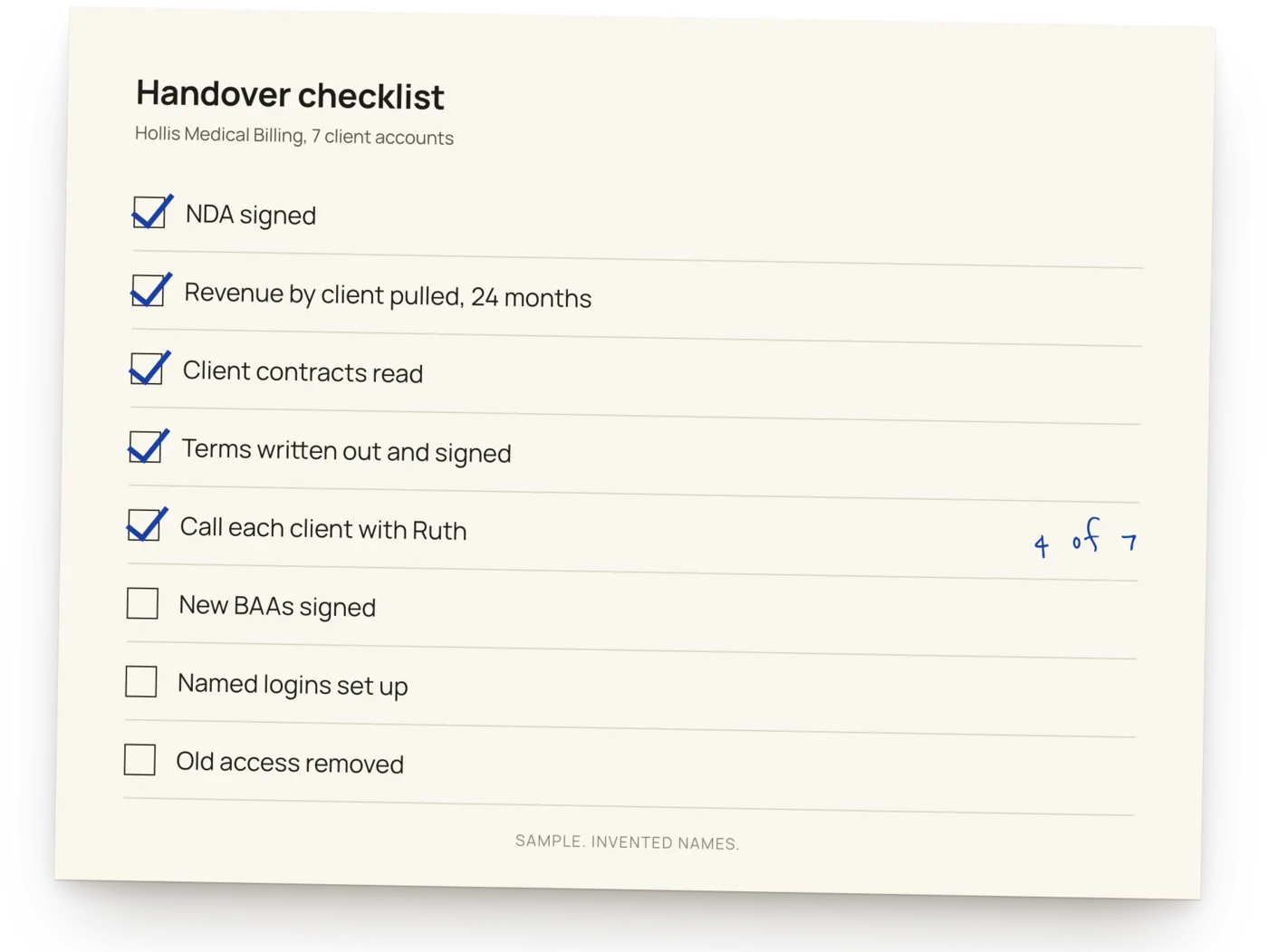
We work alongside you until clients have settled in, at a pace you've agreed to.
Our approach
How we intend to treat you and your clients
- We intend to sign an NDA before you share client names or numbers.
- Your clients hear about this from you and from us together, at a time we've agreed on.
- Each term, including how and when you'd get paid, gets written out before you sign anything.
- We don't offer interest bearing seller notes, and we won't write a loan into the agreement under the name of a revenue share.
- We'd plan the sale around keeping your clients' service running, and their data stays under HIPAA safeguards.
- If we're the wrong buyer for you, we'll say so early.
Who we'd like to meet
A good fit usually looks like this
- Independent, owner run billing companies, usually with 1 to 5 people
- About 3 to 15 active healthcare clients, though we'd also look at part of a larger list
- Billing relationships that have lasted, ideally for many years
- Owners thinking about retirement, whether that's soon or a few years off
Some business brokers only take on companies above a certain size, so a small client list can be hard to sell that way. It's the size we're looking for, and selling to us directly means no broker's commission. If we're the wrong buyer, we'll tell you so you can keep looking.
Life after billing
Plan for it while you've got options
Owners who start early can usually choose how and when they leave. Our guides cover what to get ready, and they're worth reading even if you never sell to us.

Questions
What to ask a buyer
How does a revenue share work?
You receive an agreed share of the revenue collected from the clients who transfer, for an agreed period, with no fixed price and no loan. It's our preferred structure. The share and its length, plus any cap, get negotiated with you and written into the agreement.
Do you pay anything upfront?
It depends on the business. Our preferred structure ties payments to revenue, so we aren't looking to pay a large upfront sum. If upfront money is important to you, bring it up early and we'll tell you what we can do.
What happens if a client leaves after the sale?
Your payments drop along with that client's revenue. They can also drop if we perform poorly as the buyer and clients leave because of it. That's why we'd work out the transition plan and your introductions in detail before signing.
Can my client contracts be transferred?
It depends on the contract. Some can be assigned, and others need client consent or a new agreement. We review each one during diligence, and clients can always say no.
Do I have to sell everything?
No. You can sell a selected group of accounts and keep the rest, and we'll write down how the remaining clients are treated.
How long do I need to stay involved?
That's something we'd agree on with you. You might want a short handover, or you might prefer to cut your hours over a longer period. Clients generally need some time with you to feel comfortable.
What about my staff?
We'd talk about them early. If you have employees or contractors, their roles depend on the structure of the deal, and we'd discuss that with you before anyone else hears about it.
What changes for my clients during the handover?
As little as we can manage. We'd keep service steady while you're still involved, and any changes to how the work gets done would come in slowly, with our billers reviewing coding changes and appeals.
Is this legal and tax advice?
No. Each sale has legal and tax consequences, including how payments are treated, so you should have your own attorney and tax adviser review any agreement.
This page is general information. It isn't legal or tax advice and it isn't an offer, so have your own advisers review any agreement.
Confidential
Find out what your client list might be worth
Start with your timeline and roughly how big the business is. We'll send an NDA, you send revenue by client, and we'll reply with a non binding written estimate. You aren't committing to anything, and it isn't an offer until it's in a signed agreement.