For billing company owners
How to work out seller's discretionary earnings for a billing company
A worked example of seller's discretionary earnings for a small billing company, which add backs a buyer will accept, and why it isn't the same as profit.
3 minute readBy the Fieldstone Billing teamUpdated
Your tax return may show a modest profit, since small business owners tend to run a lot through the company and pay themselves in various ways. A buyer wants to know what the business really earns for whoever owns and runs it. Seller’s discretionary earnings, or SDE, is the usual attempt at answering that for a small company.
A 2021 HBMA article on selling billing companies lists SDE as one of the ways value gets calculated, along with free cash flow and adjusted EBITDA, usually over the trailing 12 months.
The basic calculation
Start with your net profit, then add back what a new owner wouldn’t necessarily pay, or what only you benefit from:
- Your own salary or draws
- Your payroll taxes and benefits, such as health insurance
- Personal expenses paid through the company
- One time costs that won’t happen again
- Interest and depreciation
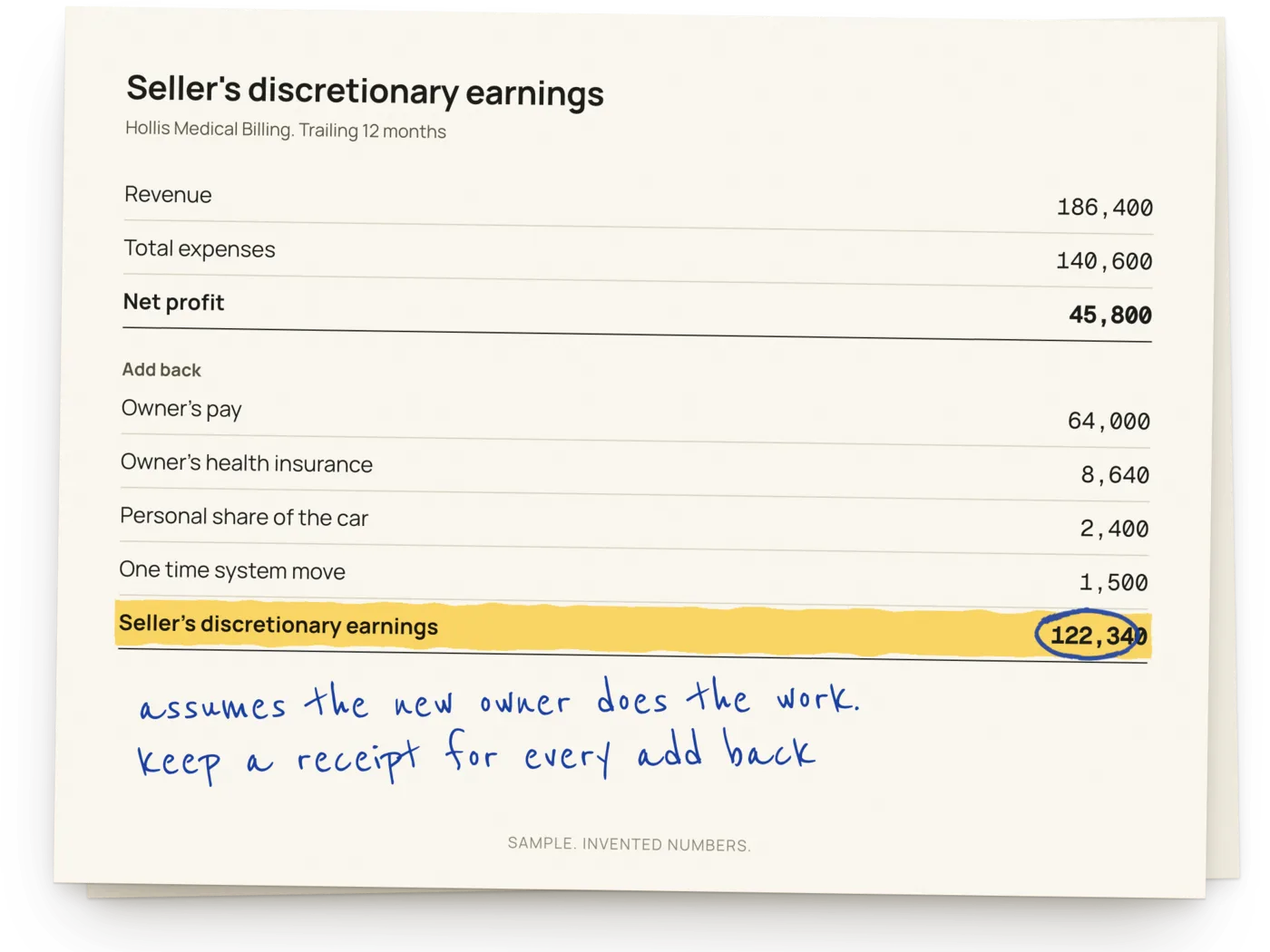
Here’s the invented company on the worksheet at the top of this page. Its revenue is $186,400 and its expenses are $140,600, so the net profit is $45,800.
| Item | Amount |
|---|---|
| Net profit | $45,800 |
| Owner’s pay | $64,000 |
| Owner’s health insurance | $8,640 |
| Personal share of the car | $2,400 |
| One time system move | $1,500 |
| SDE | $122,340 |
So this business has $122,340 a year available to a working owner, which is a very different number from $45,800.
What SDE doesn’t tell a buyer
SDE assumes the new owner does the work you do. Most buyers of a small billing company won’t. They’ll have to pay someone, so they may subtract what that would cost. If your job would take a $55,000 biller to replace, the same business earns about $67,340 for them. Be ready for a buyer to look at it that way, because it’s a fair question.
If the buyer already has spare capacity in their team, your work may cost them less to replace, which is one reason another billing company may pay more than someone new to the field.
Add backs that hold up, and ones that don’t
Add backs are where sellers lose credibility. A buyer will accept your salary and a documented personal expense easily. These get harder questions:
- Family on the payroll. If your spouse really does the posting, someone will have to do it after you sell, so that isn’t a true add back.
- Costs you’ve been putting off. Skipping a software upgrade or a compliance review makes this year look better, and a buyer can see that.
- Unusual years. One great year doesn’t mean much on its own, so the trend matters.
- Cash you haven’t reported. Don’t claim it. A buyer can’t verify it, and telling anyone creates a much bigger problem.
Keep a receipt or statement for every add back you list. If you can’t prove it, assume it won’t count.
Comparing yourself with other billing companies
That earlier HBMA article offers some rough checks from a broker’s experience: about one employee for every $80,000 to $100,000 in revenue, and labor below 50% of total revenue. Those figures are from 2021 and from one author, so use them to start a conversation with your accountant instead of treating them as targets.
What about the multiple?
We haven’t quoted one here. The multiples you’ll see online vary with company size, trend and year, and a lot of them come from people with something to sell, including buyers like us. Ask your accountant or a broker for current figures from real sales, and read what affects the value of a billing company to see which way yours might lean.
Fieldstone may be a buyer in a sale like this, so read this guide with that in mind. It's general information, and it isn't legal or tax advice.