For billing company owners
How buyers work out what a medical billing business is worth
What buyers look at when they value a billing company or client book, including verified revenue, retention, concentration and owner dependence.
3 minute readBy the Fieldstone Billing teamUpdated

There’s no single correct price for a billing business. Listings and rules of thumb can mislead you, since two businesses with the same revenue can be worth very different amounts. We may be a buyer ourselves, so treat this as a buyer’s view of the subject and check it with your own adviser.
The two numbers buyers start from
Buyers usually start from one of two numbers, then adjust for risk.
Revenue is simple to verify, and it’s often used for small client portfolios, particularly when the buyer will do the work with its own team.
seller’s discretionary earnings starts with profit, then adds back the owner’s pay and benefits, along with other costs a new owner wouldn’t carry. It shows what the business earns for one working owner, and it’s often used when buying a whole company.
Ask any buyer, us included, which one they use and how they calculate it. A price quoted without that explanation is hard to compare.
Start with revenue you can prove
Buyers look at money received, supported by deposits and invoices, over the past 12 to 24 months. Revenue you can’t document is hard to pay for. If one small client pays by check into an account you also use for household bills, you know what that money is, but a buyer has no way to verify it.
What can raise the value
Long client relationships help, because clients that have stayed through staff and system changes are likely to stay again. Contracts that can be assigned, or clients likely to consent, reduce risk. So does a broad client base where no single client makes up a large share of revenue. Documented processes mean the work can continue without relying on your memory. And buyers will look for steady profitability, since they care about what’s left after the cost of doing the work as well as the revenue.
What can lower the value
- If every client relationship runs through you personally, a transition is riskier.
- Concentration counts against you, because losing one large client could change the economics.
- A client on short notice terms, who can leave immediately, is less valuable than one on a stable contract.
- Compliance gaps such as missing BAAs or weak security create work and risk for the buyer.
- A lot of project work can pull the number down, since project revenue is usually valued lower than recurring revenue.
Two clinics with the same revenue
As an illustration, take two clinics that each pay $2,000 per month. One has a stable contract that can be transferred. The other can leave at any time and is loyal only to you. The monthly revenue looks identical on your books, and a buyer will still value the first one higher, because the second may be gone soon after you are.
How price and structure connect
Price and payment structure work together. A deal that pays over time depends on what happens after closing, so think about how likely clients are to stay when you look at the headline number. A high price paid as a share of revenue can end up paying you less than a lower price paid in cash, because your payments drop if clients leave or the buyer performs poorly.
What you can do now
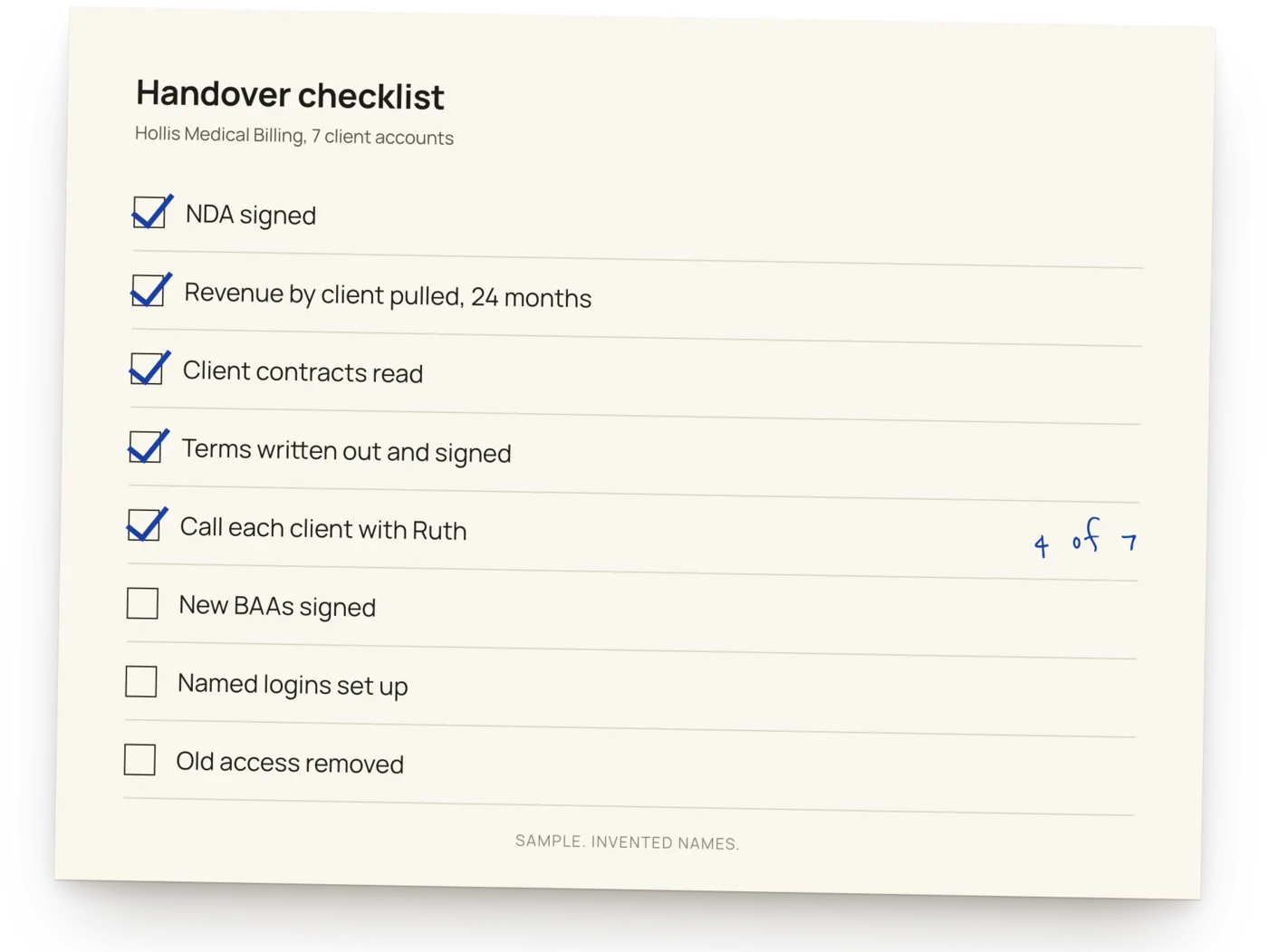
- Organize 24 months of revenue by client
- Gather your contracts, and note termination and assignment terms
- Write down how the work gets done
- Begin introducing clients to other people on your team
You’ll be glad of all this even if you end up never selling. When you’re ready, read how to sell a medical billing business, or start a confidential conversation. This guide is general information and can’t stand in for a valuation, so talk to an adviser who works on business sales about your specific situation.
Fieldstone may be a buyer in a sale like this, so read this guide with that in mind. It's general information, and it isn't legal or tax advice.